TCR-T versus a soluble TCR engager
Ask about this lessonIn one sentence
T-cell receptor therapy supplies engineered living T cells, while a soluble receptor engager supplies a protein recruiting T cells to a specified peptide–human leukocyte antigen complex.
What they share
Both specified routes recognize a peptide paired with its presenting human leukocyte antigen (HLA) molecule. Exact peptide, HLA allele and surface display matter; source protein or genotype alone proves neither display nor killing.
Before you start: A T-cell receptor (TCR) recognizes peptide and HLA together. TCR-engineered T cells (TCR-T) carry selected receptor instructions. Soluble TCR/CD3 proteins recruit T cells through cluster of differentiation 3 (CD3), the receptor-associated signaling complex.
The intuition
The same reading rule can be installed in a responder or supplied in a protein that connects another responder. The analogy locates recognition and signaling; it does not establish matched affinity, geometry, access or outcomes.
How it works: the axis is where is the receptor, and what is administered?
This pair compares conventional alpha-beta TCR-bearing cells with a soluble TCR/CD3 protein. The fictional tag P:H names one exact peptide–HLA complex. P and H are fictional identifiers. Neither product is assumed to recognize every peptide made from the source protein or another HLA allele.
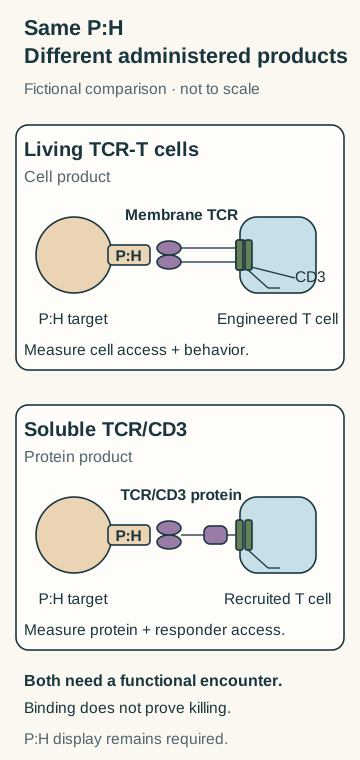
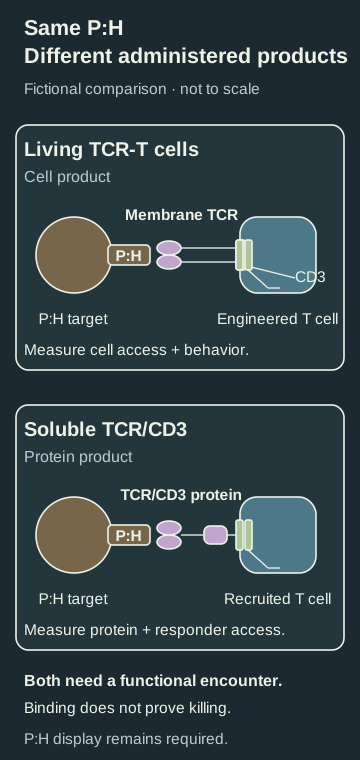
The P:H requirement is shared; the administered object and location of recognition differ. These schematic cards add exposure/control questions, without demonstrating natural display, killing or benefit.
The existing three-format table and illustration separates an antibody-derived TCR mimic from this pair. Its binder is not a TCR, even when a CD3 arm makes it an engager.
Compare the complete products
| Question | Administered TCR-T cells | Soluble TCR/CD3 protein |
|---|---|---|
| What is supplied? | Viable cells expressing selected receptor chains | A finished soluble receptor/CD3-binding protein |
| Where is recognition? | TCR at the engineered cell membrane | Soluble TCR binding region on the dosed protein |
| How does signaling connect? | Receptor-associated CD3 machinery in the engineered cell | The protein recruits another T cell through its CD3 |
| Which effectors are required? | Functional supplied cells that reach the target | Functional accessible recruited cells; their native TCR need not recognize P:H |
| What controls exposure? | Cell survival, trafficking, expansion and receptor expression | Protein dosing, distribution, clearance and productive encounters |
| What remains shared? | Actual display of the specified P:H, function and safety | Actual display of the specified P:H, function and safety |
Changing format does not repair an absent required HLA allele.
Worked example: two P:H product cards
Both fictional proposals bind a supplied P:H reagent in a controlled test:
| Field | Cell product T1 | Protein S1 |
|---|---|---|
| Identity | T cells expressing a specified conventional TCR pair | Soluble TCR recognizing P:H joined to a CD3-binding arm |
| Additional observation | Viable receptor-positive cells detected | CD3 binding measured |
| Exposure record | No trafficking or persistence results | No tissue-distribution or clearance results |
| Target evidence | No naturally presenting tumor-cell test | No naturally presenting tumor-cell test |
Try it: Which proposal supplies receptor-bearing responders, and which recruits them? Can either recognize the specified target on a wrong-allele cell by changing product format? Do reagent binding and these cards establish useful killing or controllability?
Answer: T1 supplies engineered cells; S1 supplies a recruiting protein. The specified P:H requirement remains for both. A different allele does not supply that complex, although any unintended recognition is a separate cross-reactivity question. Binding to supplied reagent leaves natural processing/display and target-cell function open. Test the finished products with naturally presenting cells, relevant allele/peptide controls, suitable effectors and healthy tissues. Track cell behavior for T1 and protein exposure for S1. Stopping a protein dose does not instantly reverse effects; a cell-control switch, if included, needs evidence for what it actually stops.
Why it matters in cancer: choose the evidence question
To ask whether surface display is present, use the existing three-target answered exercise. To ask whether supplied cells reach and remain at a site, follow T1. To ask whether protein and available T cells meet there, follow S1. These evidence plans supply no efficacy ranking or eligibility decision.
Common confusions
- A soluble TCR protein is not a living cell or a gene-delivery vehicle.
- An antibody-derived mimic is not an engineered TCR scaffold.
- Recruiting through CD3 does not remove the target's HLA requirement.
- Compatible genotype, loaded reagent binding, natural display, killing and benefit are separate findings.
- Protein clearance and cellular persistence are not interchangeable measures of control.
Explain it back
“Both read ___; T1 carries ___; S1 connects ___.”
One answer: the specified peptide–HLA complex; a receptor and signaling machinery on living cells; that target to CD3 on recruited T cells. Neither format supplies missing display or proven safety.
Takeaway
Keep the displayed target fixed, then ask whether recognition arrives on living cells or in a recruiting protein.
Related concepts
Sources and scope
Author source check: October 12, 2026. Fictional conventional-receptor/soluble-TCR comparison; no indication, ranking or eligibility inference. Scientific/visual and expert/learner review pending.
- Morgan et al., 2006 — primary abstract read: receptor gene transfer into autologous lymphocytes in metastatic melanoma. No new full-text or universal persistence/outcome claim.
- Liddy et al., 2012 — primary abstract read: soluble TCR/CD3 constructs in experimental models; full Methods and correction bodies not acquired.
- Tebentafusp prescribing information, sections 11–12.3 — selected official primary description, mechanism and protein-exposure text for one peptide–HLA/CD3 product, with no transfer of its indication or clinical results.