Reduction is not necessarily regression
In one sentence
A reduction relative to a comparison group does not establish tumor regression, which requires a decrease relative to the tumor's own earlier size under a defined assessment.
The intuition
Two plants begin the same size. One grows more slowly, so it is much smaller than the other a month later. It did not necessarily shrink. The analogy is about comparison arithmetic; tumor biology, measurement and patient outcomes need their own evidence.
When a paper says “70% reduction,” pause at the missing words: 70% relative to what? A control group, the tumor's starting measurement and its smallest previous measurement can yield very different answers.
How it works
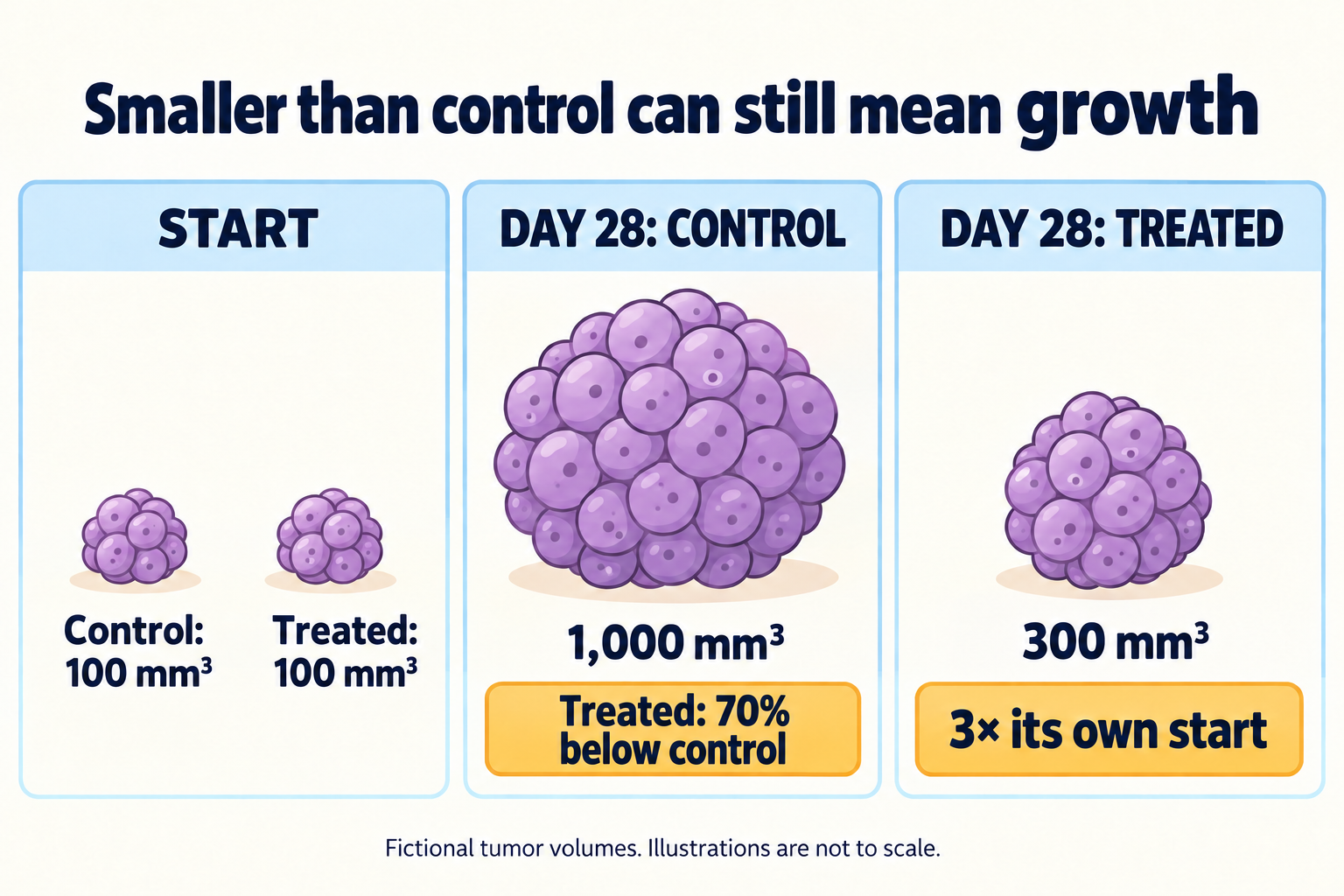
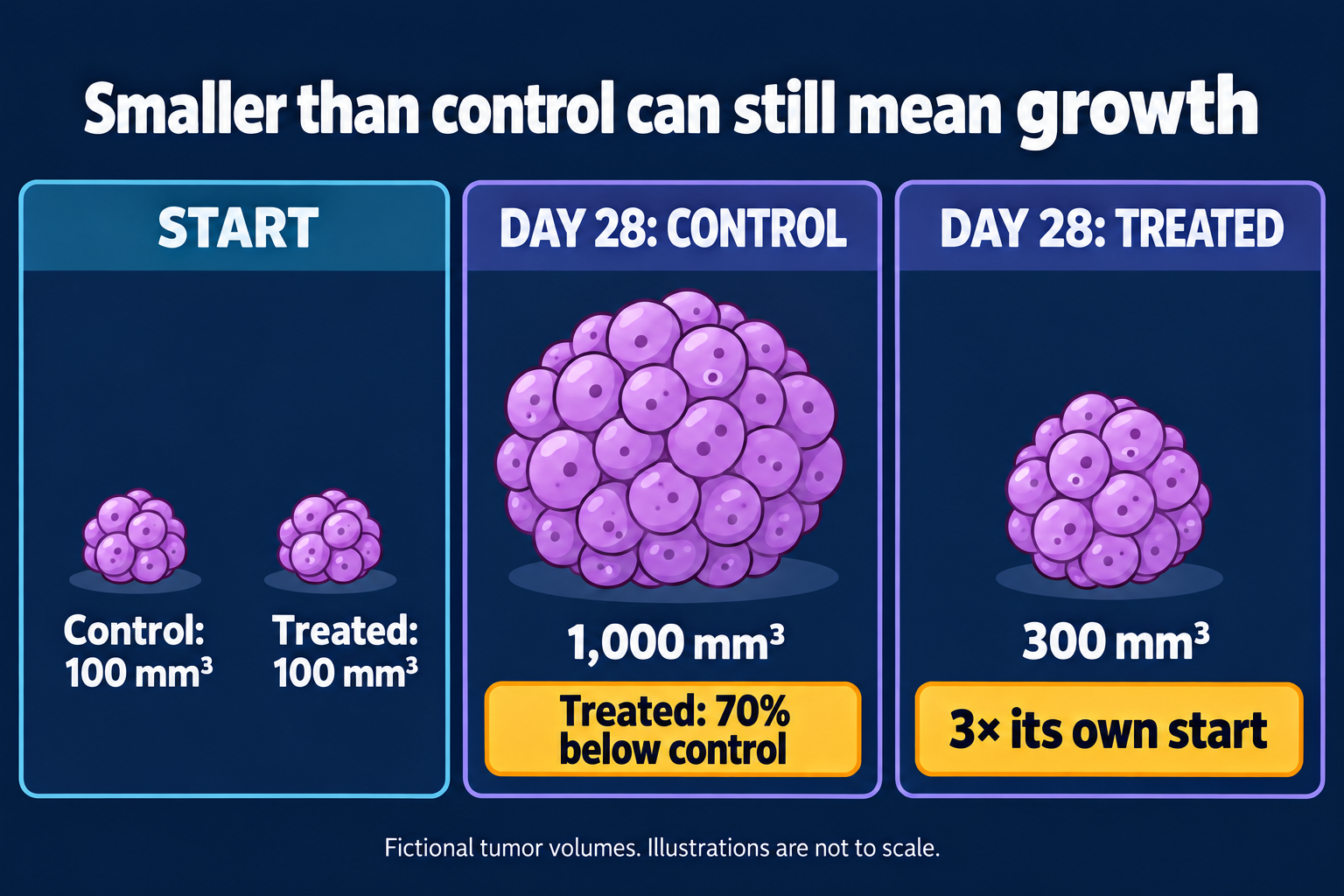
A smaller treated-versus-control comparison can coexist with growth from the starting size. These fictional volumes are not a patient response category; the drawing is not to scale. Tap the image to enlarge.
Consider a fictional preclinical experiment. Two groups have representative tumor volumes of 100 cubic millimeters (mm³) at treatment start. At day 28:
| Measurement | Control | Treated |
|---|---|---|
| Start | 100 mm³ | 100 mm³ |
| Day 28 | 1,000 mm³ | 300 mm³ |
| Change from own start | +900 mm³ | +200 mm³ |
Compared with the control at the same time, the treated volume is 70% lower: (1,000 − 300) / 1,000 = 0.70. Compared with its own start, it is three times as large, a 200% increase. This is compatible with slower growth under treatment. It is not regression from the starting size.
The table shows invented representative values, not individual observations or a statistical treatment-effect estimate. Real studies need group distributions, independent experimental units, allocation, missing measurements and uncertainty. Even “tumor growth inhibition” can use different formulas; some compare changes from baseline rather than final volumes. Recover the paper's actual calculation before quoting its percentage.
Why it matters in cancer
Response Evaluation Criteria in Solid Tumours (RECIST) uses a sum of selected lesion diameters, with specified rules for lymph nodes, non-target disease and new lesions. A percentage calculated from mouse tumor volumes cannot be inserted into a clinical diameter threshold. Cubic millimeters and millimeters measure different quantities. Eisenhauer et al., 2009.
RECIST partial response uses baseline as its comparison; target-lesion progression uses the smallest previous sum, called the nadir, plus its specified thresholds. The overall assessment also considers the rest of the disease. A decrease in one lesion does not automatically make the person an overall responder.
Nor does a lower laboratory signal necessarily describe tumor size. Cell number, metabolic activity and target-cell death are distinct readouts; use the method's actual validated quantity. A graph's axis label is part of the claim, not decoration.
The readout card
Write down:
- the measured object: tumor, selected lesions, cells or a biochemical signal;
- the units, timing and definition of the reference value;
- the calculation: final-value contrast, change from start, or another stated formula;
- the independent unit, controls, uncertainty and excluded observations.
After establishing shrinkage, ask about duration, other disease sites and harms. A tumor-size result does not supply every clinical benefit outcome. FDA oncology endpoint guidance, 2018. Response rates explains how defined responses become participant-level fractions.
Common confusions
- Smaller than control versus smaller than start: the first can occur while the tumor grows.
- 200% increase versus threefold size: both describe 100 → 300; “300% increase” would be different.
- Slower growth versus cell death: size alone does not identify the mechanism.
- Regression versus disappearance: a shrinking tumor can remain measurable; disappearance on a scan does not prove eradication.
- Statistical regression: the statistical modeling term is a different use of the word.
Try it
In another fictional experiment, a tumor starts at 100 mm³ and is measured at 60 mm³ later. The control is 300 mm³. Name both comparisons.
Answer: The treated tumor is 40% below its own start, supporting regression under this volume assessment. It is also 80% below the same-time control. Those are two different percentages. Neither establishes a RECIST category, complete eradication or patient benefit.
Explain it back
“The treated tumor was ___ compared with control, but ___ compared with its own start.” For the first table: “70% smaller; three times as large.”
Takeaway
Keep the reference value, units and time attached to every reduction claim.
For a longer worked exercise, use reading cell-therapy evidence.
Related concepts
Response criteria defines clinical measurement rules. Preclinical evidence explains what a model comparison can establish.
Sources and scope
Source check: October 10, 2026. All volume values and calculations are fictional. Clinical criteria are a separate measurement framework. Expert and learner review pending.
- Eisenhauer et al., 2009: primary RECIST 1.1 guideline — baseline, nadir and overall disease rules.
- FDA, December 2018: oncology clinical-trial endpoints — tumor activity, durability and clinical outcome interpretation.