How to engineer T cells inside the body
Before you start: DNA, RNA and protein, chimeric antigen receptor (CAR), lipid nanoparticle (LNP).
In vivo CAR-T describes where the T cells are engineered: inside the patient. It does not describe which cancer they recognize or prove that they can control a solid tumor.
Before this lesson: Building an engineered T cell.
Two manufacturing routes
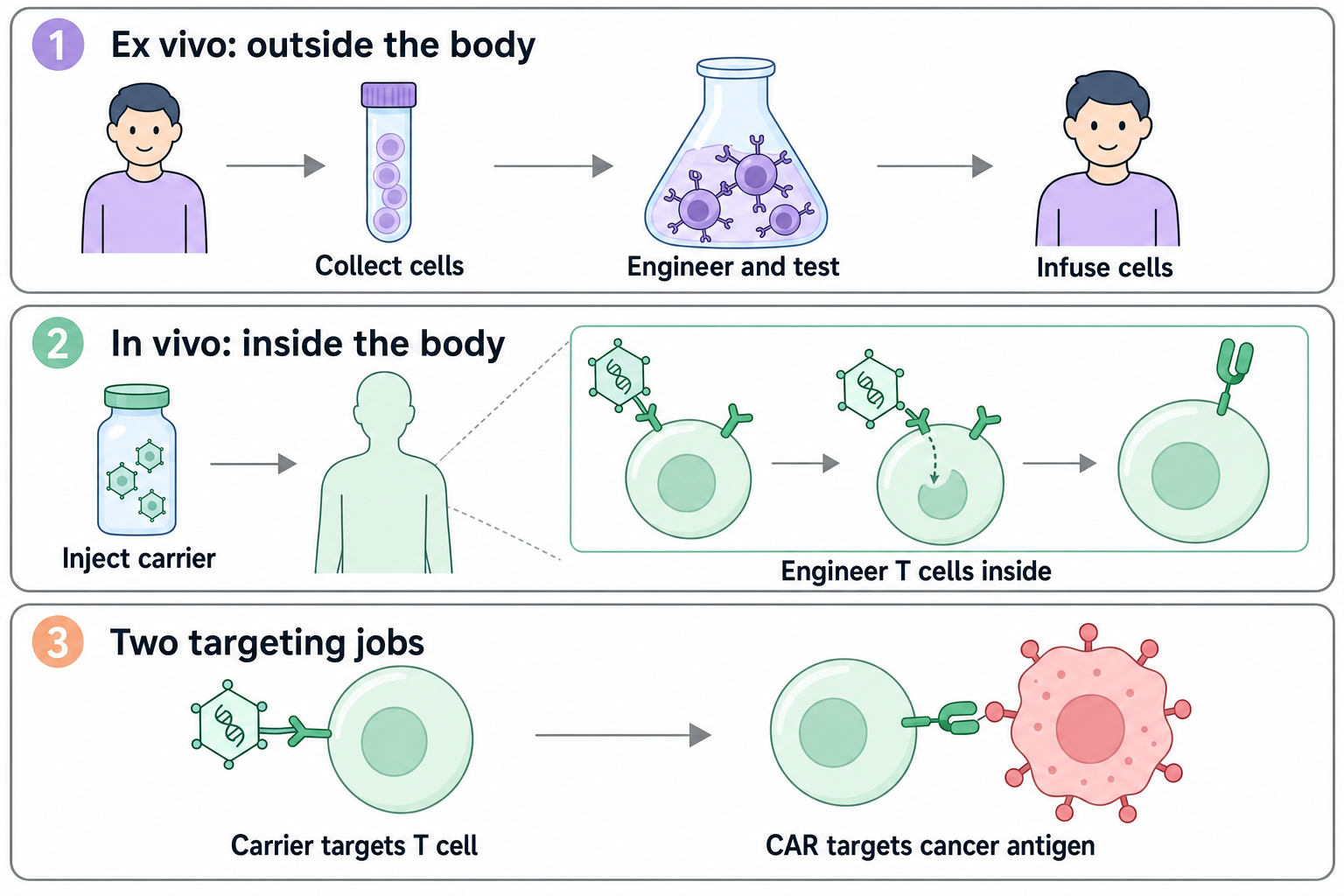
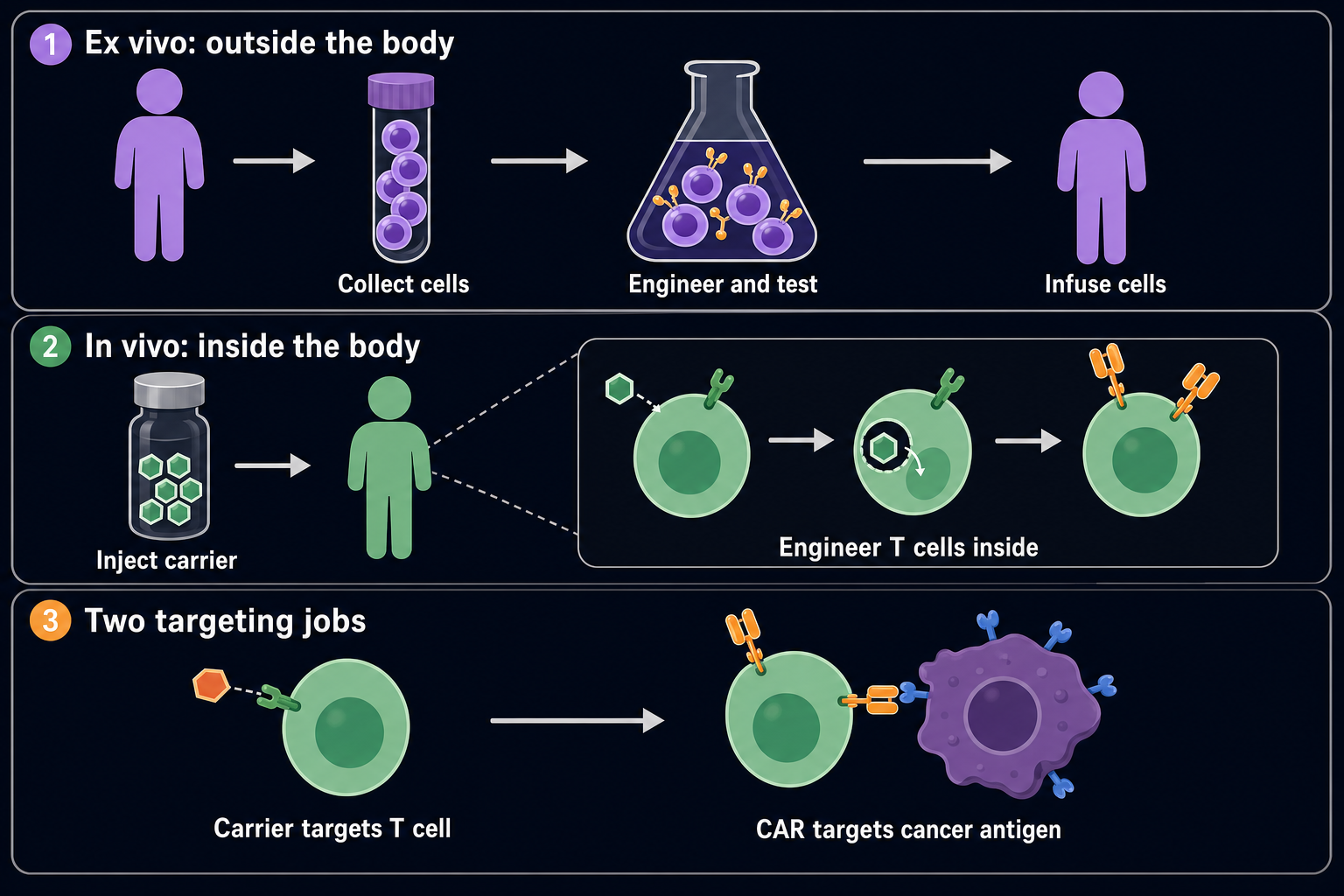
What is administered differs from the cells that ultimately perform the work.
View full-size: light illustration · dark illustration.
| Route | What happens | What is administered |
|---|---|---|
| Ex vivo: outside the body | Collect cells, engineer them in a laboratory, grow and test them, then infuse them | A manufactured population of cells |
| In vivo: inside the body | Manufacture and test a genetic delivery product; administer it so it engineers selected cells within the patient | The delivery product carrying genetic instructions |
In vivo engineering could remove patient-specific cell processing. It still requires manufacturing, quality control, and monitoring. The patient's starting T-cell number and state remain important. Whether lymphodepleting chemotherapy is needed is a property of a particular protocol, not something the words “in vivo” settle. [1,2]
Autologous versus allogeneic answers a different question: whose cells? Autologous cells come from the patient; allogeneic cells come from a donor. An off-the-shelf delivery vial may engineer the patient's own cells. “Off-the-shelf” does not necessarily mean donor cells.
Two different targeting jobs
The word “targeted” can hide two separate tasks:
- Delivery targeting: the carrier must enter the intended immune cells. A carrier that binds a T-cell marker is addressing the T cell.
- Cancer targeting: the resulting CAR must recognize the chosen cancer-cell antigen. That antigen may be entirely different from the carrier's target.
A package addressed to a T cell can contain instructions for recognizing a cancer cell. Neither targeting job proves the other worked. Delivery to the wrong cells and recognition of healthy tissue are different failure modes.
Carrier, payload, and expression
A vector or carrier transports genetic material. The payload is the material transported. Expression means the recipient cell uses those instructions to make a product. Transduction commonly describes gene delivery by a viral vector.
| Feature | Targeted mRNA lipid nanoparticles | Targeted integrating lentiviral vectors |
|---|---|---|
| Carrier | Small particles made from lipids, with a targeting strategy | Engineered viral particles with a targeting strategy |
| Delivered instructions | mRNA | A vector RNA genome that is reverse-transcribed into DNA |
| Typical route to protein | mRNA reaches cytoplasm and is translated | Vector-derived DNA integrates; the cell transcribes RNA and translates protein |
| Persistence of expression | Usually transient; depends on RNA and protein lifetime | Can persist through cell division if the engineered cells survive and expression is maintained |
| Important questions | Which cells receive RNA, endosomal escape, duration, repeat dosing, inflammation | Which cells receive the vector, integration sites, copy number, durability, immune responses |
These are representative approaches, not rules for every nanoparticle or virus. Some viral designs do not integrate. Integration describes what happens to the genetic material; it does not guarantee indefinite cell survival or permanent tumor control. [1,2]
Why a vial dose is not a final cell dose
For in vivo engineering, the administered amount of carrier is an input. The number and behavior of engineered cells are downstream outcomes.
The chain is: carrier distribution → contact with intended cells → successful entry → functional expression → cell expansion or loss → movement into tumor tissue.
A construct containing both a CAR and an added receptor also needs co-expression: the relevant cells must make both components at useful levels. Detecting one component somewhere in the body does not establish that.
Try it: resolve an ambiguous headline
Headline: “CAR-T cells eliminate tumors in vivo.”
Question: Does that mean the cells were engineered inside the animal?
Answer: No. It may mean laboratory-engineered cells were infused and then tested in a living animal. Read what was administered: cells, a vector, or nanoparticles. “Tested in vivo” and “generated in vivo” are distinct findings.
Second question: If mRNA expression fades, does the immune response stop instantly?
Answer: No. RNA decay, receptor-protein decay, cell survival, and downstream immune effects operate on different timelines.
Explain it back
“Which claim was measured, and which next step remains untested?” Name one measurement from this lesson and the limit beside it.
Takeaway and next step
In vivo engineering changes the delivery and manufacturing route. Tumor recognition, useful cell behavior, and safety still need their own evidence.
Next: Cytokines and programmable receptors.
Sources and scope
Checked September 15, 2026. Published examples validate particular constructs and experimental settings; they do not validate every in vivo CAR-T product or every solid-tumor indication.
- Hunter et al., Science, 2025: In vivo CAR T-cell generation to treat cancer and autoimmune disease. Targeted mRNA nanoparticles; human-cell experiments, tumor control in humanized mice, and B-cell depletion in monkeys. This is not evidence of human solid-tumor efficacy.
- A targeting lentiviral vector for generation of CAR-T cells in vivo, Scientific Reports. CD19-targeted activity in a lymphoma mouse model; possible solid-tumor adaptations are not the same as tested solid-tumor efficacy.