Gamma-delta T-cell foundations
Gamma-delta T cells are T cells, but they do not behave like the conventional alpha-beta T cells most immunotherapy discussions assume. Their T-cell receptor is built from gamma and delta chains rather than alpha and beta chains, and their recognition is less dependent on classical peptide-HLA presentation.
That makes them interesting for tumors that may escape vaccines or TCR-T through HLA/B2M loss. It does not automatically make them proven cancer drugs.
Alpha-beta versus gamma-delta
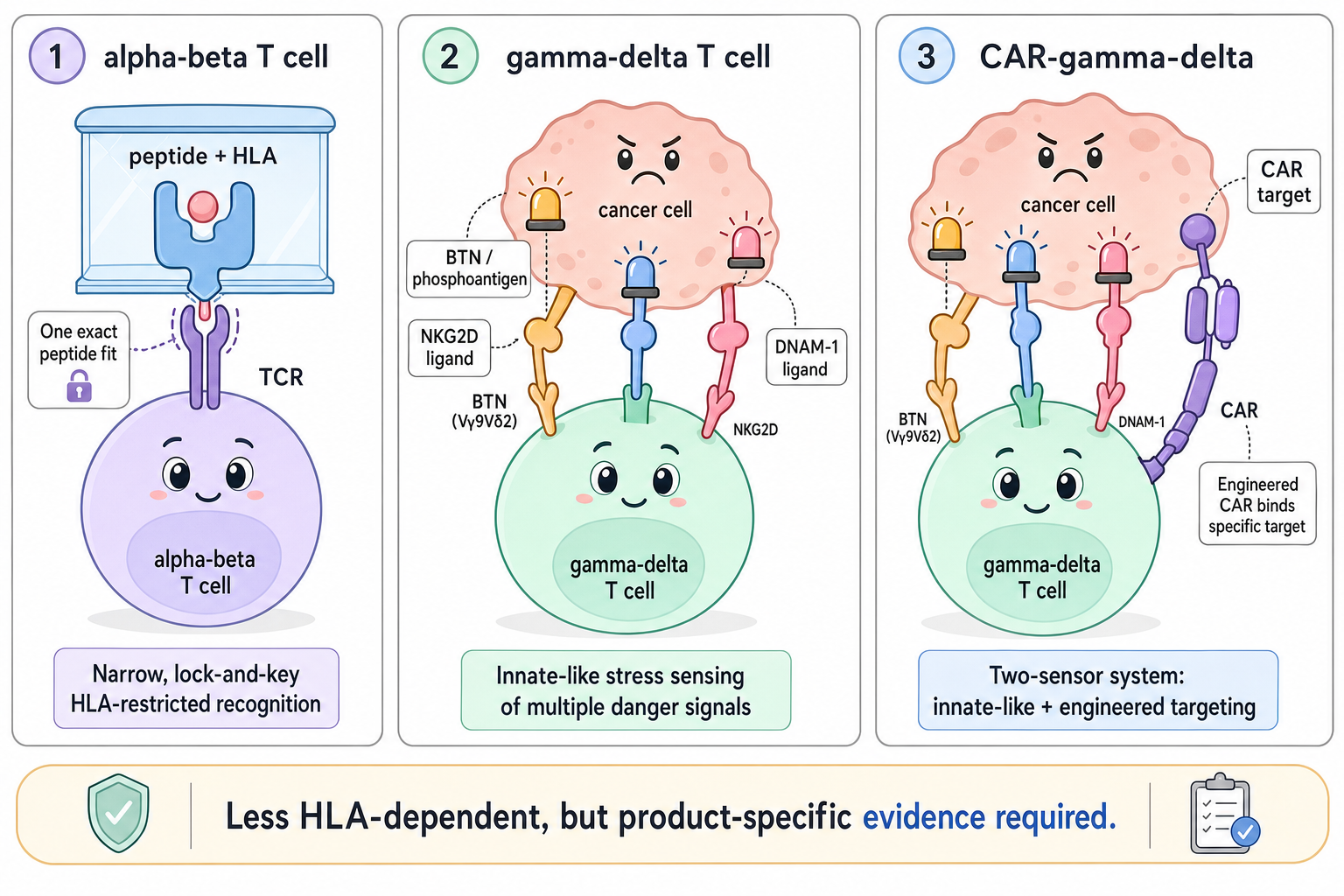
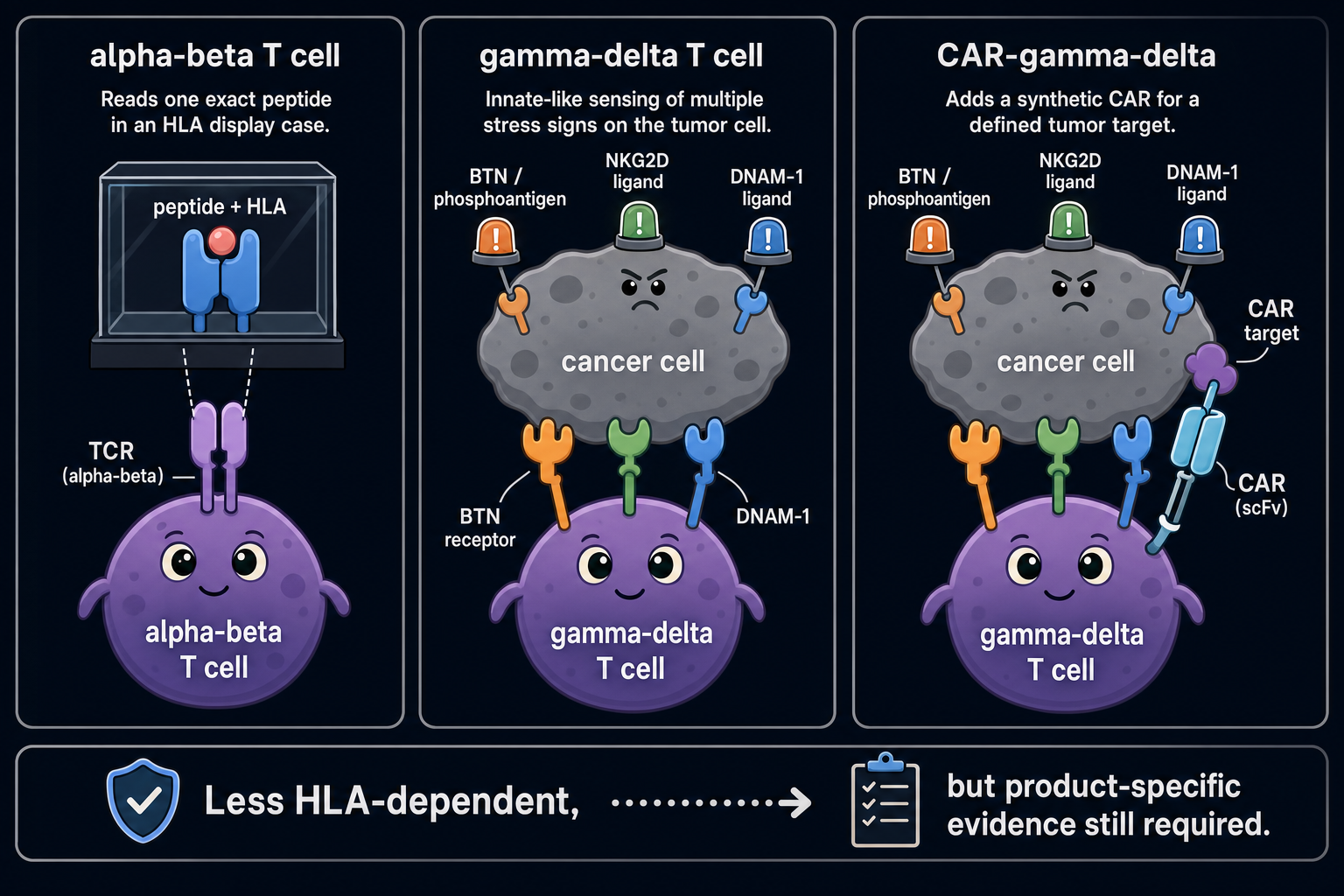
Conventional alpha-beta T cells mostly ask:
"Is the exact peptide I recognize sitting in the right HLA molecule?"
Gamma-delta T cells can ask broader stress questions:
"Does this cell look transformed, stressed, metabolically abnormal, or displaying a nonclassical danger signal?"
That is why gamma-delta approaches are often described as "innate-like." They sit between adaptive T cells and innate NK cells.
The main gamma-delta subsets
| Subset | Common location | Recognition themes | Why it matters |
|---|---|---|---|
| Vgamma9Vdelta2 | Blood-enriched | Phosphoantigen / BTN2A1 / BTN3A1 axis; metabolic stress | Easier to collect and expand from blood; common clinical manufacturing starting point. |
| Vdelta1 | Tissue-enriched | Stress ligands, epithelial/tissue surveillance, tumor-reactive tissue residency | Often emphasized for solid tumors and epithelial cancers; harder manufacturing questions. |
| Polyclonal gamma-delta | Mixed | Multiple gamma-delta subsets retained | Broader recognition but less defined product biology. |
| CAR-gamma-delta | Engineered product | CAR target plus retained innate-like gamma-delta biology | Adds a named surface target while preserving HLA-independent pressure. |
What gamma-delta cells can recognize
Gamma-delta recognition is not one receptor-one-lock in the simple CAR sense. It can include:
- BTN2A1 / BTN3A1 / phosphoantigen axis — especially for Vgamma9Vdelta2 cells sensing altered isoprenoid metabolism.
- NKG2D ligands — stress ligands that can rise on damaged or transformed cells.
- DNAM-1 ligands — adhesion/stress-related recognition partners.
- NKp30 / NKp44 and other NK-like receptors — innate-like activation signals on some gamma-delta products.
- HLA-G or other tolerance/stress ligands — depending on the engineered CAR or product design.
- CAR target — a synthetic surface-antigen binder layered onto the cell.
The key point: for any real product, ask which of these axes is actually part of the intended mechanism. "Gamma-delta" alone is not enough.
Why gamma-delta may help after HLA/B2M loss
Vaccines and TCR-T require tumor peptides to be shown on HLA. B2M loss can remove surface HLA-I and make those approaches go blind. Gamma-delta cells may retain tumor recognition through stress-ligand or nonclassical pathways, and CAR-gamma-delta cells can add direct surface-antigen binding.
This is a rationale, not a guarantee. Diana still needs target/ligand confirmation and product-specific evidence.
CAR-gamma-delta: two recognition systems in one cell
A CAR-gamma-delta product tries to combine:
- CAR-directed specificity — the engineered receptor binds a named tumor surface target.
- Gamma-delta innate-like recognition — the underlying cell may still respond to stress biology beyond the CAR.
- Allogeneic/off-the-shelf feasibility — lower graft-versus-host risk than conventional alpha-beta allogeneic T cells, if the product is cleanly manufactured.
The concept is attractive for solid tumors because the CAR gives a clean target and gamma-delta biology may add HLA-independent pressure. The clinical risk is that both halves have to work in real patients, not just diagrams.
What the field has and has not shown
| Evidence layer | What it supports | What it does not prove |
|---|---|---|
| TNBC immune-correlation studies | Gamma-delta abundance can associate with better prognosis or immune state. | That infused gamma-delta cells will shrink TNBC. |
| HLA/B2M-loss mechanism papers | HLA-defective tumors can still interact with gamma-delta effectors in some contexts. | That this works in Diana's tumor or in TNBC trials. |
| Preclinical CAR-gamma-delta models | Engineered gamma-delta cells can kill target-positive cancer models. | Human efficacy, trafficking, durability, or safety. |
| Early/basket trials | Feasibility and safety signals may emerge. | Standard-of-care efficacy. |