Cytokines and programmable receptors
Before you start: chimeric antigen receptor (CAR), T-cell priming, T-cell states.
Recognizing a cancer cell and remaining able to fight it are different jobs. Cytokine signaling is one way to influence the second job.
Before this lesson: How to engineer T cells inside the body.
Message, receiver, and response
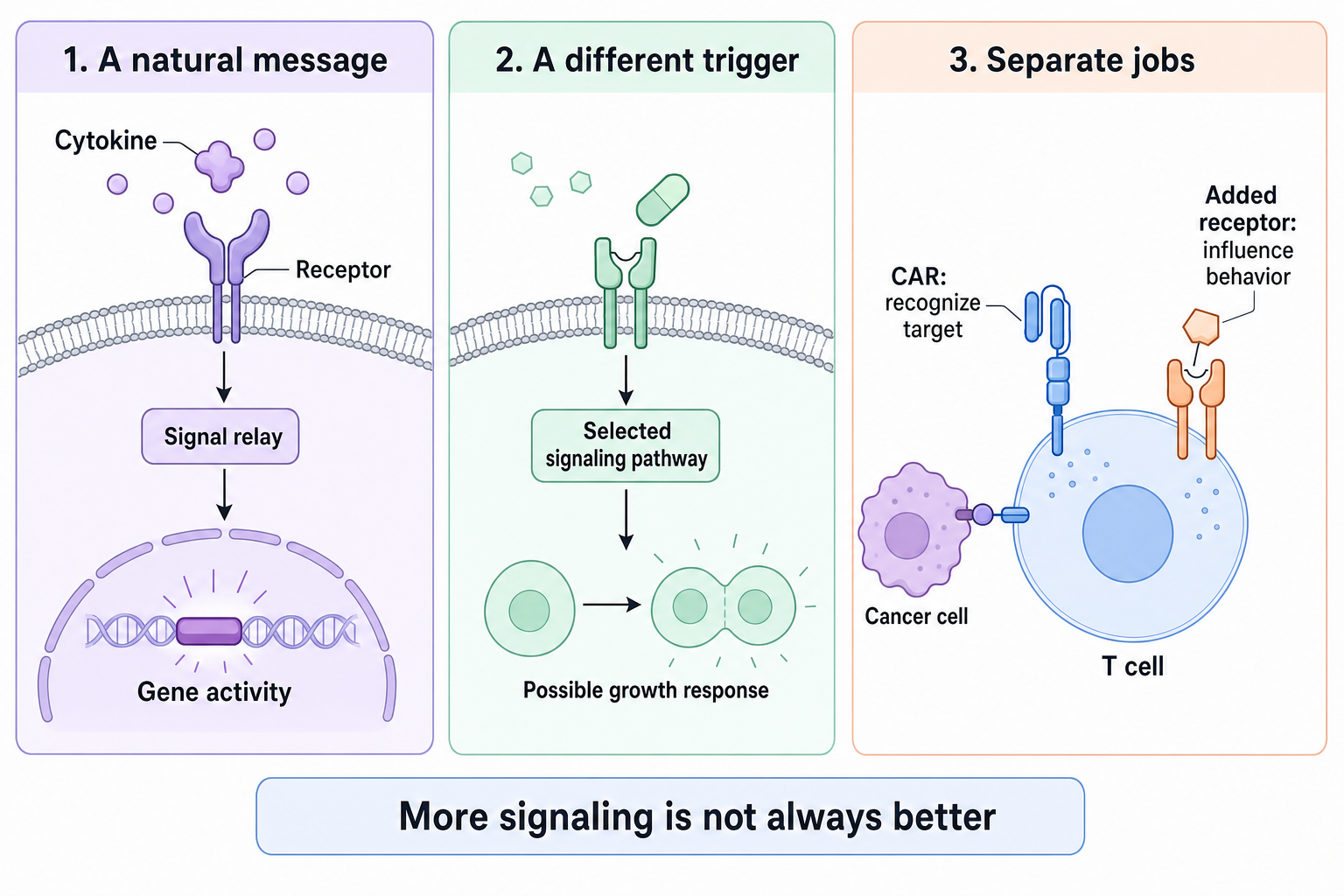
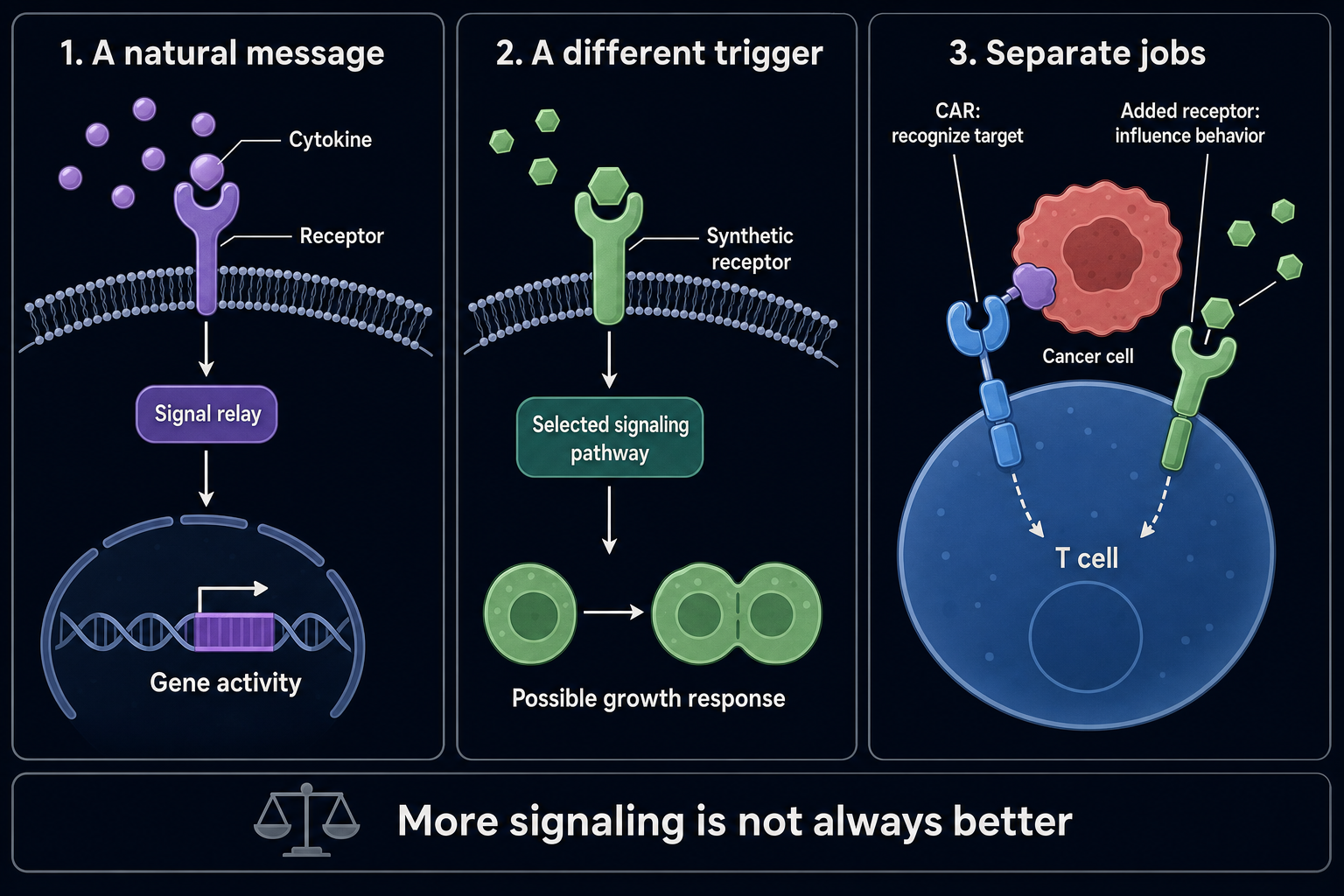
Supportive signaling is a separate job from recognizing a tumor antigen.
View full-size: light illustration · dark illustration.
A cytokine is a signaling protein. A receptor receives a compatible signal. A signaling pathway relays that information inside the cell. The resulting phenotype is the cell's observable state or behavior.
The sequence is:
Extracellular signal → receptor activation → intracellular signaling → altered cell behavior.
A cytokine does not carry a literal command such as “cure cancer.” The response depends on the receptor, dose, duration, cell type, and other signals. The same cytokine can affect different cell populations differently. For example, IL-2 can support both effector T cells and regulatory T cells; more signaling is not automatically better for antitumor activity.
Cytokines are messages, not nutritional fuel. Cells still require nutrients and suitable metabolic conditions to act on a signal.
What happens inside the membrane
Many cytokine receptors use JAK–STAT signaling. JAK proteins are enzymes associated with the receptor; activation can add phosphate groups to signaling proteins. STAT proteins can then influence which genes are expressed. This links an external message to a change in the cell's internal program.
That is one common route, not the only route. Cytokine receptors can engage other pathways, and receptor activation has feedback and timing effects. A diagram with one arrow summarizes a network, not a guaranteed response. Synthetic-receptor experiments demonstrate that changing the receptor's external trigger can still activate selected intracellular pathways. [1]
What synthetic receptor engineering changes
Imagine keeping a useful internal signaling mechanism but changing what activates it. A synthetic receptor can connect a chosen input to that mechanism.
| Input design | Intended benefit | What still needs testing |
|---|---|---|
| Drug-triggered | Adjust activity through an administered molecule | Baseline activity, effective dose, how quickly activity falls after withdrawal |
| Antigen-triggered | Link activity to a molecular feature in a location or on a cell | Where else the trigger occurs, activation threshold, distribution of effects |
| Constitutive: always active | Provide support without another administered trigger | Uncontrolled growth, persistent activation, exhaustion, and ways to terminate harmful cells |
An orthogonal ligand/receptor pair is designed to interact selectively with its engineered partner. Selectivity needs measurement. A screen can compare signaling outputs, but the selected receptor must still improve the finished therapy in the intended cells and disease setting.
An added receptor can influence growth without changing the CAR’s antigen. Receptor-driven intracellular signaling is also different from secreting a cytokine into surrounding tissue. Stronger signaling can add harmful activity as well as useful effects.
Growth, persistence, and function are separate measurements
| Finding | What it tells us | What it leaves open |
|---|---|---|
| More cells at a time point | Greater net cell accumulation | Division, survival, or movement may each contribute |
| Cells remain detectable | Persistence | Whether they are in the tumor and still functional |
| More killing in a dish | Activity in that assay | Trafficking, tissue safety, and durable benefit in a body |
| Lower tumor burden | Antitumor activity under those conditions | Durability, recurrence, toxicity, and clinical benefit |
Try it: a growth switch is not a kill switch
Scenario: A drug activates an added receptor. Stopping the drug reduces its signal. Does that remove the engineered T cells?
Answer: Not necessarily. The cells and their CARs may remain. An activity switch adjusts behavior; a cell-elimination switch is designed to remove cells. Neither should be assumed from a tumor-volume curve showing drug-on versus drug-off groups.
Explain it back
“Which claim was measured, and which next step remains untested?” Name one measurement from this lesson and the limit beside it.
Takeaway and next step
Programmable signaling could improve cell behavior, but stronger or longer signaling can create new tradeoffs.
Next: The journey through a solid tumor.
Sources and scope
Source check: October 8, 2026; expert and learner review pending. General mechanisms; specific construct behavior requires its own evidence.