Gamma-delta decision framework
Gamma-delta therapy is a compelling idea for Diana only if it clears a sequence of gates. Safety language or "HLA-independent" language is not enough. The product has to match Diana's actual tumor and a real access path.
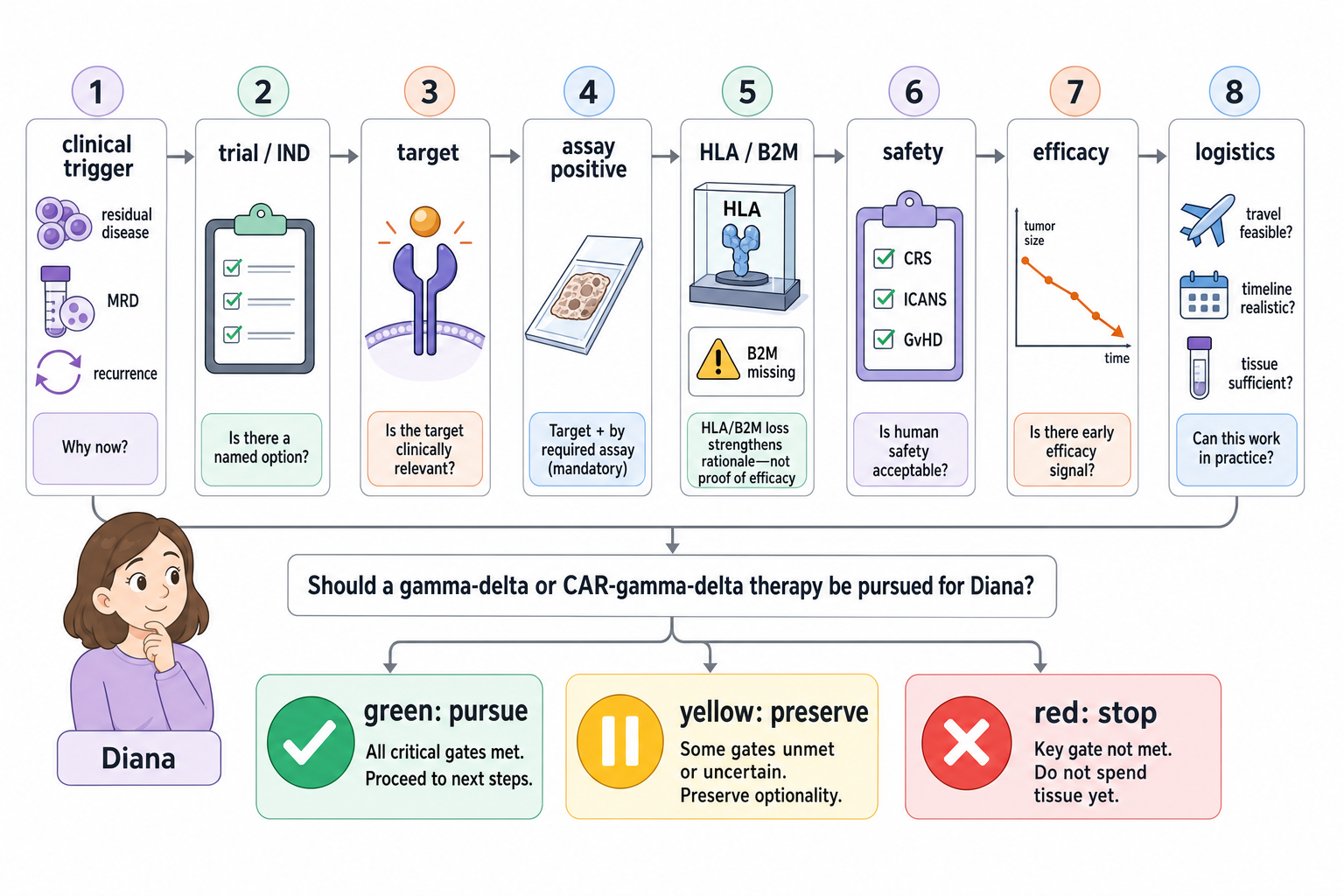
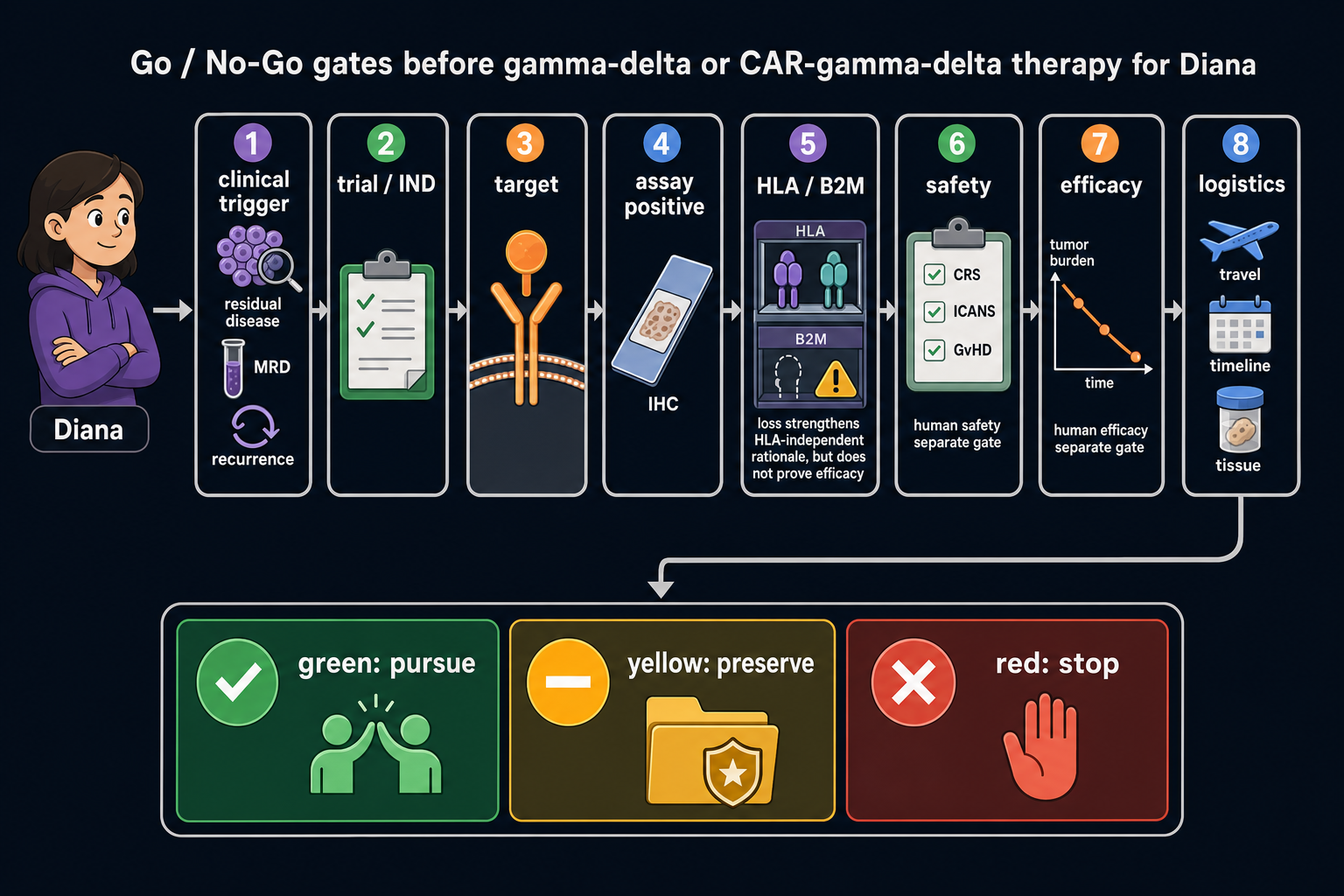
The decision sequence
| Gate | What we need to see | Why it matters |
|---|---|---|
| 1. Clinical trigger | Residual disease, MRD positivity, recurrence, or metastatic disease | Without a trigger, this is optionality, not treatment. |
| 2. Product identity | Exact product, sponsor, NCT/IND, site, phase, and whether it is recruiting TNBC | Avoids treating a platform claim as an access path. |
| 3. Recognition mechanism | CAR target, gamma-delta subset, stress-ligand axis, BTN/phosphoantigen axis, NKG2D/HLA-G/other ligand details | "Gamma-delta" is a cell type, not a mechanism. |
| 4. Diana target match | Required assay and cutoff positive on Diana's tumor, preferably recent residual/recurrent tissue | No target match, no rationale. |
| 5. HLA/B2M context | HLA-LOH, B2M, APM, HLA-I IHC/RNA status | HLA loss strengthens the reason to favor HLA-independent approaches. |
| 6. Human safety | CRS, ICANS, GvHD, DLTs, cytopenias, infection, alpha-beta contamination, hospitalization | "Safer than conventional T cells" still needs data. |
| 7. Human efficacy | TNBC responses if available; otherwise same-target solid-tumor responses with caveats | Preclinical killing is not enough for treatment. |
| 8. Logistics | Prior lines, pembrolizumab history, lymphodepletion, travel, manufacturing timeline, tissue requirements | A promising trial can still be inaccessible or disproportionate. |
Green / yellow / red rule
Green: actively screen or pursue
All of these should be true:
- Diana has a clinical trigger.
- The trial/IND/access path is named.
- The target or ligand is positive by the required assay.
- The mechanism fits Diana's HLA/B2M/APM state.
- Human safety is acceptable.
- Human efficacy is credible enough for the disease state.
- Logistics do not displace a better standard option.
Yellow: learn and preserve optionality
This is the current default for most gamma-delta leads:
- credible investigator or sponsor,
- plausible TNBC biology,
- target/assay not yet disclosed,
- no current clinical trigger,
- evidence still preclinical or basket-level,
- testing can be done without wasting scarce tissue.
Red: do not spend tissue or money now
Stop if:
- no target is named,
- no assay/cutoff is named,
- no NCT/IND/site is named,
- tissue is being requested without a clear access consequence,
- evidence is only company-supplied and lacks patient-level safety/response detail,
- or the therapy requires lymphodepletion/travel that is disproportionate to current risk.
The Meisam / CARTx intro version
For an intro call, the short ask list is:
- What is the exact product and trial/IND?
- What is the CAR target or recognition axis?
- Which gamma-delta subset is used?
- What assay and cutoff define eligibility?
- Have they tested HLA-I-low or B2M-knockout TNBC models?
- What human safety data exist?
- Are there TNBC patient responses, or only preclinical data?
- Does prior pembrolizumab or KEYNOTE-522 therapy affect eligibility?
- Is tissue target confirmation the only bottleneck, or is leukopak/PBMC collection useful?
What would make it the right idea for Diana?
The strongest case would look like this:
Diana has residual/recurrent disease; HLA-I/B2M is impaired or peptide-HLA strategies look weak; the product is a named CAR-gamma-delta trial; Diana's tumor is positive for the exact target by the trial assay; early human data show manageable CRS/ICANS/GvHD and at least same-target solid-tumor activity; and the logistics fit without sacrificing a better standard therapy.
Anything short of that stays in the learn/preserve-optional category.