The journey through a solid tumor
Before you start: chimeric antigen receptor (CAR), T-cell states, immune escape.
A useful CAR-T cell must reach the cancer, recognize it, remain functional, and do enough damage without unacceptable harm. Increasing the cell count addresses only part of that chain.
Before this lesson: Cytokines and programmable receptors.
Four obstacles to follow
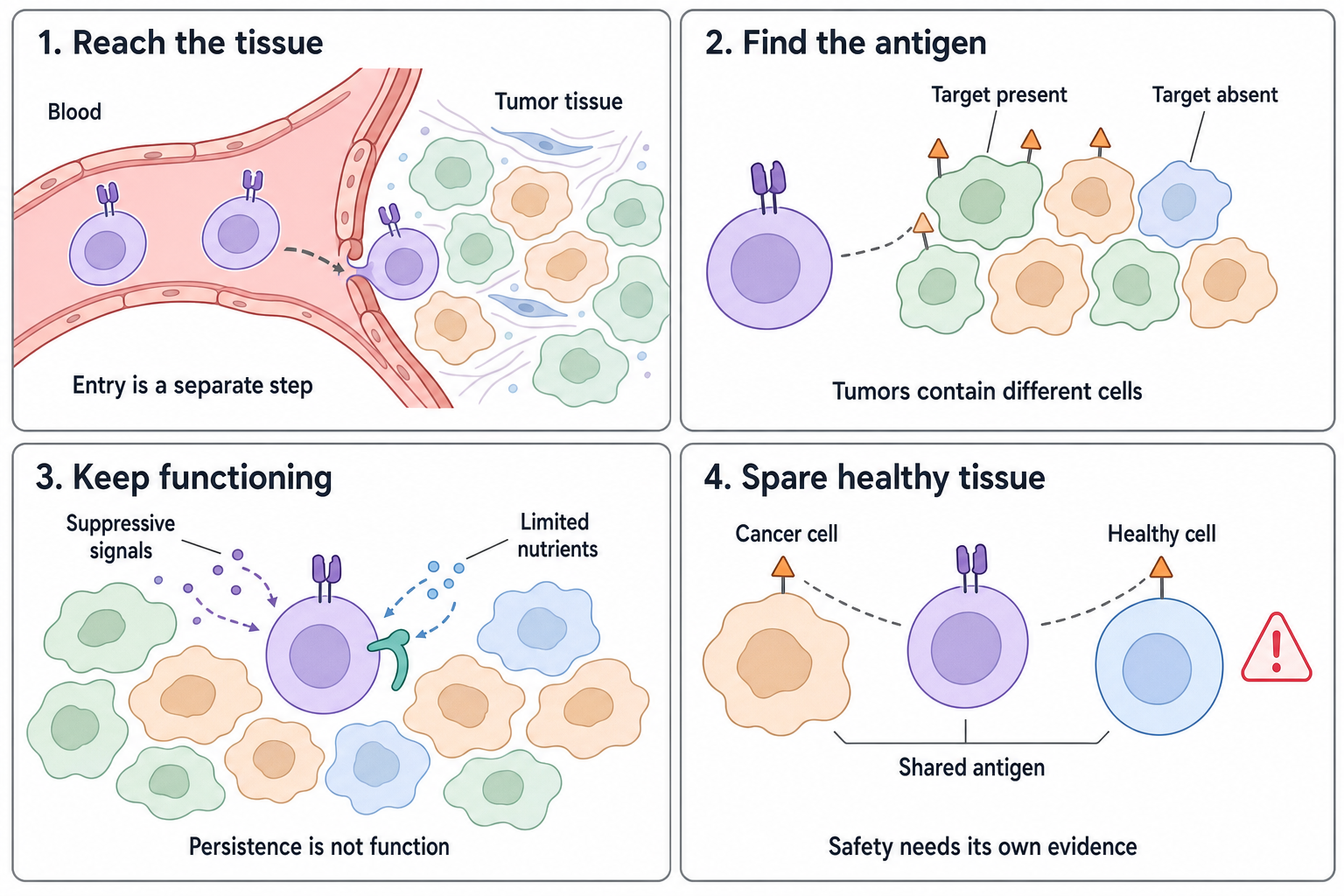
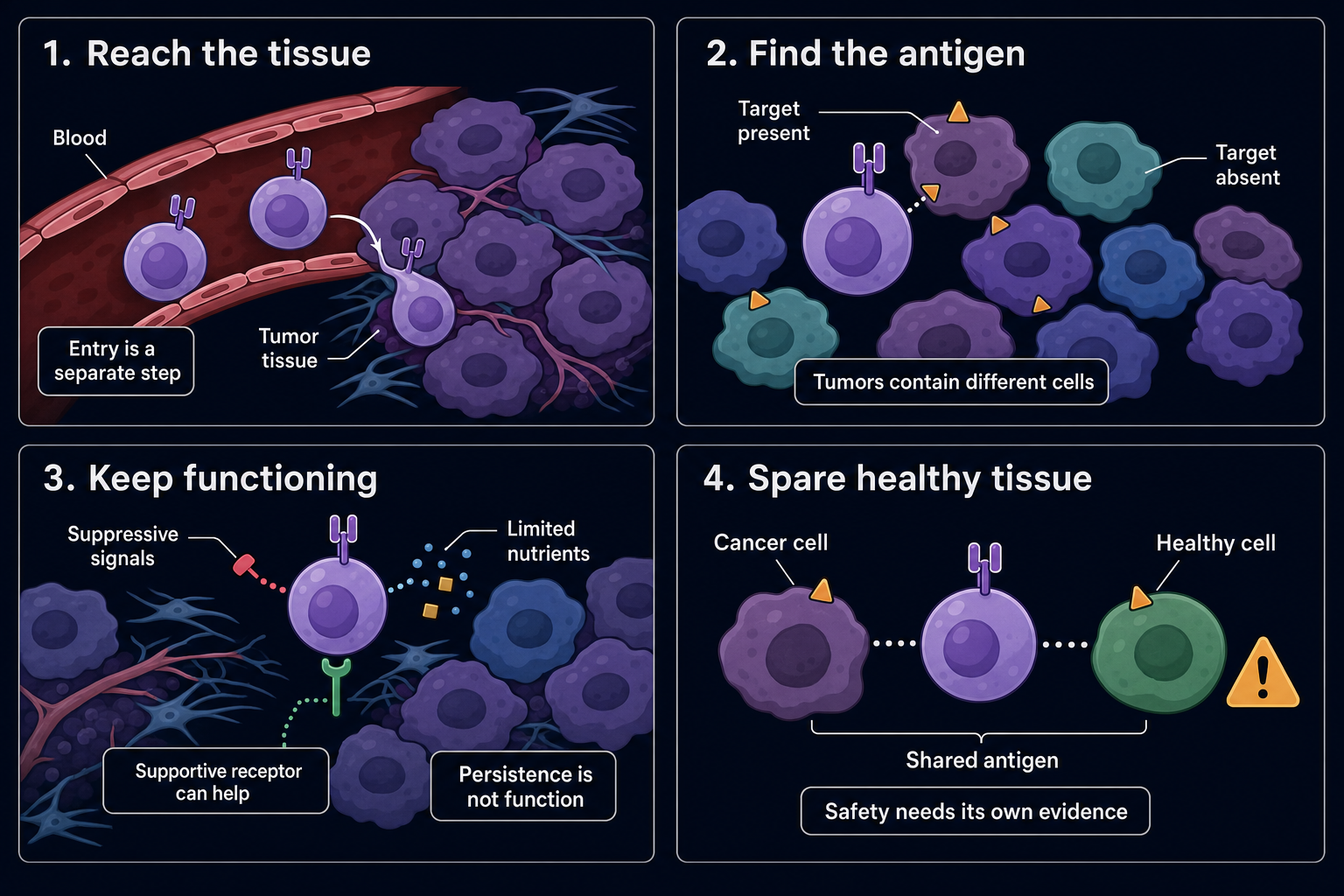
Improving one link does not guarantee that the whole treatment chain works.
View full-size: light illustration · dark illustration.
1. Reach and enter the tumor
Trafficking means movement toward a site; infiltration means entering the tissue. Cells measured in blood or spleen have not necessarily entered the cancer. Tumor blood vessels, physical tissue structure, and local chemical signals can impede access. [1,2]
The tumor microenvironment includes cancer cells, immune cells, blood vessels, fibroblasts, and extracellular material. A tumor is an ecosystem, not just a pile of identical cancer cells.
2. Recognize enough cancer cells
A surface target must be accessible and present at a level the CAR can respond to. A high RNA measurement does not automatically establish high surface-protein expression.
Heterogeneity means variation. Some cancer cells may display much of a target, others little, and others none. Different metastases may also differ. Antigen escape occurs when cells that are not effectively recognized survive and grow; this can involve selection of pre-existing target-low cells as well as changes over time. [1]
Conventional CAR recognition does not require a peptide to be displayed on human leukocyte antigen (HLA). That removes one recognition dependency; it does not remove the need for an appropriate surface target. See the recognition comparison.
3. Keep working in a hostile environment
Suppressive signals, limited nutrients, low oxygen, and repeated stimulation can undermine function. Exhaustion describes a biological state associated with chronic stimulation and altered function; it is not simply a cell being briefly tired.
Persistence means cells remain present. Functional persistence means they remain capable of useful activity. A supportive cytokine receptor might help with one aspect of this problem; it does not supply oxygen or guarantee access to every cancer cell. Experimental approaches that deliver cytokines locally have improved mouse outcomes, but their results are specific to the tested constructs and models. [2]
4. Preserve healthy tissue
The same antigen can appear on cancer and normal cells. On-target, off-tumor toxicity means the receptor recognizes its intended antigen in an unwanted place. It differs from off-target recognition, in which the binding machinery reacts with an unintended molecular target.
Stronger activation can increase useful killing and harmful activity. Therapeutic window means the range in which benefit is achievable without unacceptable toxicity. It must be measured for the actual product and setting. [1,3]
A worked example: target coverage
Made-up teaching example, not patient data or a prediction: Imagine 100 cancer cells. Eighty display target X strongly and 20 lack it. A CAR-X treatment kills all 80 target-positive cells in this simplified model.
The tumor has become much smaller, but 20 target-negative cells remain. Making ten times as many CAR-X cells does not create target X on those survivors. Real treatments can recruit other immune effects, but that requires evidence; it should not be assumed from the CAR's specificity.
What might address this gap? A second recognition target or a demonstrated broader immune response might help. Each introduces its own design and safety questions.
Match the tool to the problem
| Proposed improvement | Problem it may address | Problem it does not automatically solve |
|---|---|---|
| Better T-cell delivery vector | Generating engineered cells | Choosing a safe cancer antigen |
| Another CAR target | Recognition coverage | Safe expression of both targets in normal tissue |
| Added cytokine receptor | Growth, survival, or functional state | Missing antigen or inaccessible tissue |
| Improved trafficking machinery | Reaching tumor sites | Retaining activity after arrival |
| Drug-controlled signaling | Adjusting a particular pathway | Immediate removal of all engineered cells |
Try it: read a biopsy and a blood result together
Scenario: Engineered T cells rise in blood, but a tumor biopsy contains few of them. What is the next question?
Answer: Ask about distribution and infiltration before concluding that more expansion is needed. Blood counts, tumor-cell entry, and tumor killing are separate readouts. Sampling time and biopsy representativeness also matter.
What “breast cancer” tells us
The indication name is not a molecular target. Even the label TNBC does not identify one universal CAR antigen. A program needs a defined target, evidence of accessible expression across relevant cancer cells, normal-tissue testing, and a named development or clinical protocol. A pipeline label alone does not establish eligibility or access.
Explain it back
“Which claim was measured, and which next step remains untested?” Name one measurement from this lesson and the limit beside it.
Takeaway and next step
Solid-tumor efficacy is a chain of linked requirements. A result at one link cannot stand in for the whole chain.
Next: Read the safety plan.
Sources and scope
Checked September 15, 2026. The numerical example is deliberately fictional. These lessons do not infer eligibility for a particular treatment.
References
- NCI: CAR T cells, including barriers in solid tumors.
- Rewiring endogenous genes in CAR T cells for tumour-restricted payload delivery, Nature, 2025. Preclinical evidence for locally controlled cytokine expression; not in vivo generation of the CAR-T cells.
- FDA: CAR T-cell product development considerations.